Ok, that sounds really weird. Let me explain.
I have a son, he's about 2 year old and is showing some interest in the toilet and in potty training. I think it's difficult for boys, especially those who stay home with their mothers since they generally only see people urinating in a sitting position.
Perhaps I'm overly sensitive to issues of toilet training for boys but I decided I needed to show him how men are supposed to do it.
This weekend I had a couple of opportunities to take him with me to public bathrooms. Each time we took a large stall. The first time he watches me stand over the toilet bowl and..and..Nothing. Shy Bladder strikes.
He's watching me, absolutely fascinated as to what we're waiting for and what is going to happen next. Staring wild-eyed in a way only a 2 year old can, no hint of embarrassment for my predicament.
I'm thinking to myself, he's 2 years old. I'm suffering Shy Bladder in front of my 2 year old. After what seems an eternity but is probably only 10-12 seconds I decide that we should sing a song he knows. We sing and within a few seconds I'm able to go.
Later episodes were similar except that I didn't have to resort to the singing, I was just willing to wait a few seconds more knowing that I would be able to go at some time as soon as I'd relaxed enough.
The moral of the story? I'm not sure there is one but one of the reasons I decided to try to beat my Shy Bladder was exactly this - I wanted to be normal around my Son and be a good role model to him. It seems that Shy Bladder can run in families and I didn't want to pass it on.
Monday, May 15, 2006


Friday, March 31, 2006
How to make a plan for graduated exposure.
In his book, Edmund Bourne explains how to construct a plan for Graduated Exposure Therapy. This is also covered in Steven Soifers book on Shy Bladder. If I put those together with my own experience here's what I think you should do (Remember, I'm not a doctor, this is not medical advice).
Step 1 : Identify Where You Are.
You want to get started on defeating your Shy Bladder symptoms but first it's a good idea to take a hard look at your condition. It might help to answer for yourself some of the following questions and writing down your answers. You can always shred the paper later but writing this down may give you some insight into your particular case.
Questions :
* What was the first time I experienced this problem?
* How has it affected my life?
* Does anyone know that I suffer with this?
* If I have told someone, what was their reaction?
* Does anyone in my family have this condition? (it does seem to run in families)
* What have I already tried to overcome this condition?
* Under what circumstances am I able to go?
* Under what circumstances am I definately unable to go?
Step 2 : Get Physicians advice.
I know, I know. This is the step we all hate and many of us skip. It may be you know that you don't need to see a MD but it's always a good idea to remove any physical problems from the picture. Chances are however that if you can go at home but not in a public restroom the problem isn't an enlarged prostate or other problem, it's Shy Bladder.
Step 3 : Choose your weapons
Another good reason for getting a physicians advice is that you might choose a Selective Serotonin Reuptake Inhibitor (SSRI) drug. It's worth reading the International Paruresis Associations (IPA) drug page for a full treatment of this subject. It may be that not all SSRI's are created equal. The IPA hints at anecdotal evidence that Paxil may actually be useful for Shy Bladder. Again, this is not medical advice, talk to your physician.
Hypnosis? Some have reported that they used Hypnosis in their programs to overcome Shy Bladder.
Cognitive Behavioral Therapy (CBT). This is a form of Psychotherapy that works to "restructure" the negative and unhelpful thoughts that plague Shy Bladder sufferers - you know the ones "Everyone is watching me, they've noticed I can't go" or "Someone is going to come into the bathroom any second..." Normally CBT will be combined with Graduated Exposure Therapy.
Graduated Exposure Therapy. My tool of choice and the one recommended in all the books as a therapy that's simple, cheap and effective (if you're persistent).
You can do graduated exposure therapy yourself and/or you can choose to jump-start your recovery by attending a Graduated Exposure Therapy workshop (run by the IPA), by joining a support group or by finding yourself a Pee-Buddy.
Step 4 : Identify your scale
Maybe you can't go anywhere except at home with the door firmly locked and only when you know there's nobody else in the house or maybe you can go in a public restroom but only in a locked stall. We all have to start somewhere. The important thing is to identify the steps that it will take to reach freedom.
So create a scale, a series of steps 8-20 in all that will act as milestones in your progress. When I started I was unable to use a public restroom except in a locked stall, sitting down to minimize the noise. Here's my scale :
Since Shy Bladder is a Social Anxiety I ensured that I only practiced when people were around.
I figure once I reach #9 I'll be pretty much free though I may always have a tendency to slip back so I will always have to practice at least a few times a week. I've made it as high as step 8, but right now I'm somewhere around step 6-7. This is a normal pattern of advancement and dropping back slightly.
Step 5 : Have a backout plan
In step 6 you're going to start practicing the graduated exposure therapy but first plan an exit strategy in case you are unable to go. Make sure you have a bathroom identified (at home maybe) that you can reach in case you get into trouble. This might include knowing where the nearest hospital is in case you need to be catheterized to relieve the pressure. I've never needed this safe bathroom in my progress but you might.
Step 6 : Execute the plan.
Now the fight. If you're doing hypnosis, CBT and drugs you have it relatively easy. If you're doing Graduated Exposure Therapy you have to overcome the natural tendency not to drink. You need to drink, a lot, in order to give yourself opportunities to practice and you need to maintain high urgency levels.
Drinking 100+oz's of water a day isn't easy and it can be torture waiting around with very high levels of urgency in order to ensure that there are others around when you go. You'll be sitting in meetings and all you can think about is how bad you need to go. But you can progress this way, rapidly.
Step 7 : Keep a diary
Not really a step this more a peice of advice. I've kept a diary via this weblog and I am always amazed as I read it how often I failed or fell-back. I've also re-experienced the euphoria of a good day - these are all things that I wouldn't remember if I wasn't keeping a detailed diary of what I did, how if felt and what I thought. You're progress won't be linear, you'll jump ahead and fall-back on your steps but keep trying and you'll have a breakthrough day or two as I did when it seemed like you were already free of Shy Bladder and that give you a glimpse of what you're life will be like once you made it through.
Good luck! Post in this blog to let us know how you're doing.
Further reading :
Step 1 : Identify Where You Are.
You want to get started on defeating your Shy Bladder symptoms but first it's a good idea to take a hard look at your condition. It might help to answer for yourself some of the following questions and writing down your answers. You can always shred the paper later but writing this down may give you some insight into your particular case.
Questions :
* What was the first time I experienced this problem?
* How has it affected my life?
* Does anyone know that I suffer with this?
* If I have told someone, what was their reaction?
* Does anyone in my family have this condition? (it does seem to run in families)
* What have I already tried to overcome this condition?
* Under what circumstances am I able to go?
* Under what circumstances am I definately unable to go?
Step 2 : Get Physicians advice.
I know, I know. This is the step we all hate and many of us skip. It may be you know that you don't need to see a MD but it's always a good idea to remove any physical problems from the picture. Chances are however that if you can go at home but not in a public restroom the problem isn't an enlarged prostate or other problem, it's Shy Bladder.
Step 3 : Choose your weapons
Another good reason for getting a physicians advice is that you might choose a Selective Serotonin Reuptake Inhibitor (SSRI) drug. It's worth reading the International Paruresis Associations (IPA) drug page for a full treatment of this subject. It may be that not all SSRI's are created equal. The IPA hints at anecdotal evidence that Paxil may actually be useful for Shy Bladder. Again, this is not medical advice, talk to your physician.
Hypnosis? Some have reported that they used Hypnosis in their programs to overcome Shy Bladder.
Cognitive Behavioral Therapy (CBT). This is a form of Psychotherapy that works to "restructure" the negative and unhelpful thoughts that plague Shy Bladder sufferers - you know the ones "Everyone is watching me, they've noticed I can't go" or "Someone is going to come into the bathroom any second..." Normally CBT will be combined with Graduated Exposure Therapy.
Graduated Exposure Therapy. My tool of choice and the one recommended in all the books as a therapy that's simple, cheap and effective (if you're persistent).
You can do graduated exposure therapy yourself and/or you can choose to jump-start your recovery by attending a Graduated Exposure Therapy workshop (run by the IPA), by joining a support group or by finding yourself a Pee-Buddy.
Step 4 : Identify your scale
Maybe you can't go anywhere except at home with the door firmly locked and only when you know there's nobody else in the house or maybe you can go in a public restroom but only in a locked stall. We all have to start somewhere. The important thing is to identify the steps that it will take to reach freedom.
So create a scale, a series of steps 8-20 in all that will act as milestones in your progress. When I started I was unable to use a public restroom except in a locked stall, sitting down to minimize the noise. Here's my scale :
1. Locked stall, standing up.
2. Unlocked stall, standing up.
3. Unlocked stall, door ajar, standing up.
4. Unlocked stall, door wide open, standing up.
5. Unlocked stall nearest the urinals, door wide open, standing up.
6. Urinal #1 (of 3), waiting until someone else comes in.
7. Urinal #2 (of 3), waiting until someone else comes in.
8. Urinal #2 (of 3), waiting until someone stands next to you to initiate flow.
8. Urinal #2 (of 3), in a crowded bathroom.
9. Any urinal at a high-throughput venue such as a stadium, airport or bar.
Since Shy Bladder is a Social Anxiety I ensured that I only practiced when people were around.
I figure once I reach #9 I'll be pretty much free though I may always have a tendency to slip back so I will always have to practice at least a few times a week. I've made it as high as step 8, but right now I'm somewhere around step 6-7. This is a normal pattern of advancement and dropping back slightly.
Step 5 : Have a backout plan
In step 6 you're going to start practicing the graduated exposure therapy but first plan an exit strategy in case you are unable to go. Make sure you have a bathroom identified (at home maybe) that you can reach in case you get into trouble. This might include knowing where the nearest hospital is in case you need to be catheterized to relieve the pressure. I've never needed this safe bathroom in my progress but you might.
Step 6 : Execute the plan.
Now the fight. If you're doing hypnosis, CBT and drugs you have it relatively easy. If you're doing Graduated Exposure Therapy you have to overcome the natural tendency not to drink. You need to drink, a lot, in order to give yourself opportunities to practice and you need to maintain high urgency levels.
Drinking 100+oz's of water a day isn't easy and it can be torture waiting around with very high levels of urgency in order to ensure that there are others around when you go. You'll be sitting in meetings and all you can think about is how bad you need to go. But you can progress this way, rapidly.
Step 7 : Keep a diary
Not really a step this more a peice of advice. I've kept a diary via this weblog and I am always amazed as I read it how often I failed or fell-back. I've also re-experienced the euphoria of a good day - these are all things that I wouldn't remember if I wasn't keeping a detailed diary of what I did, how if felt and what I thought. You're progress won't be linear, you'll jump ahead and fall-back on your steps but keep trying and you'll have a breakthrough day or two as I did when it seemed like you were already free of Shy Bladder and that give you a glimpse of what you're life will be like once you made it through.
Good luck! Post in this blog to let us know how you're doing.
Further reading :
What to do when you fail.
Recovery Stories
My plan to beat Shy Bladder.
Getting help for Shy Bladder
Thursday, March 30, 2006
What is a normal level of hesitancy?
You're at the urinal and in the presence of others, what is a normal delay before you can urinate?
If you suffer Shy Bladder you probably know, you've counted the eons worrying that this time you just arn't going to start at all or that the next guy is judging you because you don't seem to be able to start.
I was in a stall recently (for all the right reasons mind you), right next to the urinal and I couldn't help but overhear two guys at the urinal. I counted, it was five seconds before one of them was able to initiate a flow.
Five seconds is an age when you're standing there counting it. It would probably have made me anxious but this guy doesn't suffer from Shy Bladder so he didn't even think about it.
If you suffer Shy Bladder you probably know, you've counted the eons worrying that this time you just arn't going to start at all or that the next guy is judging you because you don't seem to be able to start.
I was in a stall recently (for all the right reasons mind you), right next to the urinal and I couldn't help but overhear two guys at the urinal. I counted, it was five seconds before one of them was able to initiate a flow.
Five seconds is an age when you're standing there counting it. It would probably have made me anxious but this guy doesn't suffer from Shy Bladder so he didn't even think about it.
Can you cure shy bladder just by drinking water?
There seems to be an idea floating around the internet of a "water cure". The suggestion is that dehydration is the cause of many modern ills and that if we just stopped drinking coffee, soda and tea and stuck to good old plain purified water we'd be so much better off.
There may be some truth to it, but as a cure for Shy Bladder (as some have suggested) I think it's pretty unlikely (I'd like to hear from anyone that the "water cure" worked for - please post a comment)
Since Shy Bladder is a social phobia it seems unlikely that just drinking more water would be an effective cure. Would it cure, for instance, a fear of travelling in elevators (another social anxiety)? Very Doubtful.
What drinking lots of fresh water WILL do for you is give you plenty of chances to visit the bathroom and practice your graduated exposure therapy. That's a technique that will work to lessen the effects of and (if you're persistent enough) cure your Shy Bladder symptoms.
Having said that, there's nothing dangerous about the water cure and I'd be very happy to hear that it is an effective cure for Shy Bladder.
There may be some truth to it, but as a cure for Shy Bladder (as some have suggested) I think it's pretty unlikely (I'd like to hear from anyone that the "water cure" worked for - please post a comment)
Since Shy Bladder is a social phobia it seems unlikely that just drinking more water would be an effective cure. Would it cure, for instance, a fear of travelling in elevators (another social anxiety)? Very Doubtful.
What drinking lots of fresh water WILL do for you is give you plenty of chances to visit the bathroom and practice your graduated exposure therapy. That's a technique that will work to lessen the effects of and (if you're persistent enough) cure your Shy Bladder symptoms.
Having said that, there's nothing dangerous about the water cure and I'd be very happy to hear that it is an effective cure for Shy Bladder.
Sunday, March 26, 2006
Book : Coping With Anxiety.
This book by Edmund Bourne and Laura Garano has a chapter on Phobia's (Chapter 4, Face your fears). This is a great chapter on Exposure therapy. Among the highlights :
* You need between 8 and 20 steps in your plan.
* You will have up and down days, hit plateau's, jump forward and fall backward. This is normal! They write about people with a social phobia of going to the supermarket :
* You just practice regularly 3-5 times per week. Generally longer sessions of exposure are better than shorter sessions.
* It can take between a month and a year to fully recover.
* You have to trust your own pace.
* You can use Imagery desensitization to help "practice" situations in which you suffer Shy Bladder.
* If you want to really get cured you have to progress through all steps, stopping at some level of comfort short of cured will not do it.
It's just one chapter of the whole book but I found it very helpful.
* You need between 8 and 20 steps in your plan.
* You will have up and down days, hit plateau's, jump forward and fall backward. This is normal! They write about people with a social phobia of going to the supermarket :
On a given Monday you might spend five minutes alone in the grocery store for the first time in years. On Tuesday you can endure five minutes again but no more. On Wednesday you are unable to go into the store at all. Thursday or Friday you discover that you can last ten minutes in the store. This up-and-down, two-steps-forward-one-step-back phenomenon is typical of exposure therapy. Don't let it discourage you!
* You just practice regularly 3-5 times per week. Generally longer sessions of exposure are better than shorter sessions.
* It can take between a month and a year to fully recover.
* You have to trust your own pace.
* You can use Imagery desensitization to help "practice" situations in which you suffer Shy Bladder.
* If you want to really get cured you have to progress through all steps, stopping at some level of comfort short of cured will not do it.
It's just one chapter of the whole book but I found it very helpful.
Monday, March 20, 2006
Progress Report #15 : Back and Forth
Attempt #1 : Urgency 7.5/10. Went to the bathroom, met someone else just going in. He took Urinal #3, I took Urinal #1. Stood up to the urinal and became aware that I was thinking about going rather than going. Naturally, nothing happened. I have a kind of nervous habit that I've developed in this kind of a situation, I scratch my nose. Despite my lack of flow my anxiety didn't spike and after about 3 seconds (which seemed like forever) I started my flow and was able to go normally.Success!
What I'm learning : Recently I've had a spate of hesitancy before finally being able to go. It happens when my urgency isn't 10/10. My anxiety isn't kicking in like it used to in these situations though and I am able to go after a few seconds. Hesitancy is normal Sure. People can tell you that, you can read it, you can even see it in other people at urinals but unless you can understand that yourself at a subconscious level it doesn't help you. But I think that my subconscious mind is starting to grasp it, the fact that my anxiety doesn't start up after a second or two of waiting suggests I'm "getting it". Just how much hesitancy is normal?
Attempt #2Urgency 7/10. Arrived at bathroom during high-traffic time. Felt a flash of anxiety. Someone at urinal #2, took urinal #1. Froze. Was able to start flow as soon as they left urinal and were in process of leaving room. Maybe I would have started had they stayed in the bathroom longer. Dissapointing failure. Failure.
After a weekend...
Attempt #3Urgency 8/10. Again arrived at bathroom during a high-traffic time. Did not feel anxiety, someone at Urinal #1, Someone at #3. A perfect practice set-up. I stood up to urinal #2 and was able to go immediately. It probably helped that the guy at #3 flushed and left at that moment. The guy at #1 was still there when I finally left the bathroom. I guess Shy Bladder comes to us all - but not me this time! Success!
A few days later..
Attempt #4Urgency 8/10. Arrive in the bathroom, someone is at urinal #1 so I take #3 which, for some reason has me feeling more exposed (I guess I'm not next to the wall as usual). I stand there but nothing happens until the other guy leaves the room. I shrug and realize that sometimes you're just going to have a bad day. I don't worry about it.Failure.
Summary
I seem to be in a pattern of moving forward and falling back with my Shy Bladder progress. I was pleased to discover that Edmund Bourne says that this is normal in a program of Graduated Exposure Therapy. Read more about his book.
What I'm learning : Recently I've had a spate of hesitancy before finally being able to go. It happens when my urgency isn't 10/10. My anxiety isn't kicking in like it used to in these situations though and I am able to go after a few seconds. Hesitancy is normal Sure. People can tell you that, you can read it, you can even see it in other people at urinals but unless you can understand that yourself at a subconscious level it doesn't help you. But I think that my subconscious mind is starting to grasp it, the fact that my anxiety doesn't start up after a second or two of waiting suggests I'm "getting it". Just how much hesitancy is normal?
Attempt #2Urgency 7/10. Arrived at bathroom during high-traffic time. Felt a flash of anxiety. Someone at urinal #2, took urinal #1. Froze. Was able to start flow as soon as they left urinal and were in process of leaving room. Maybe I would have started had they stayed in the bathroom longer. Dissapointing failure. Failure.
After a weekend...
Attempt #3Urgency 8/10. Again arrived at bathroom during a high-traffic time. Did not feel anxiety, someone at Urinal #1, Someone at #3. A perfect practice set-up. I stood up to urinal #2 and was able to go immediately. It probably helped that the guy at #3 flushed and left at that moment. The guy at #1 was still there when I finally left the bathroom. I guess Shy Bladder comes to us all - but not me this time! Success!
A few days later..
Attempt #4Urgency 8/10. Arrive in the bathroom, someone is at urinal #1 so I take #3 which, for some reason has me feeling more exposed (I guess I'm not next to the wall as usual). I stand there but nothing happens until the other guy leaves the room. I shrug and realize that sometimes you're just going to have a bad day. I don't worry about it.Failure.
Summary
I seem to be in a pattern of moving forward and falling back with my Shy Bladder progress. I was pleased to discover that Edmund Bourne says that this is normal in a program of Graduated Exposure Therapy. Read more about his book.
Sunday, March 19, 2006
Slate article on Shy Bladder
Here : http://www.slate.com/id/2065670/
One of the interesting quotes from the article (by Steven Soifer, author of the book, and recovering Shy Bladder sufferer himself :
This is not the sort of thing I like to hear. I want to know that I can make it to 100% cured and stay that way. Even so, I would be happy to be in remission for the rest of my life. Suffering Shy Bladder might be like an addiction in that way, you can be "free" but the experience of ever having had it leaves you forever changed and forever potentially susceptible. "JohnW" suggests as much in his recovery story (analysis of recover stories here).
That's a good enough reason to work on Graduated Exposure Therapy now, so that should I slip back I will always have the tools necessary to cure myself again.
Further reading :
One of the interesting quotes from the article (by Steven Soifer, author of the book, and recovering Shy Bladder sufferer himself :
Even with therapy, will a shy bladder ever feel at ease at the ballpark trough? "I've suffered from paruresis for 30 years," Soifer says, "and I've been in recovery for the last six. I'm not cured. It's a lot like alcoholism. You can recover close to 100 percent, but it can get set off again in certain situations. That's why I don't talk about a cure.
This is not the sort of thing I like to hear. I want to know that I can make it to 100% cured and stay that way. Even so, I would be happy to be in remission for the rest of my life. Suffering Shy Bladder might be like an addiction in that way, you can be "free" but the experience of ever having had it leaves you forever changed and forever potentially susceptible. "JohnW" suggests as much in his recovery story (analysis of recover stories here).
That's a good enough reason to work on Graduated Exposure Therapy now, so that should I slip back I will always have the tools necessary to cure myself again.
Further reading :
Can you ever really be cured of Shy Bladder?
Wednesday, March 15, 2006
Progress Report #14 : I'm Back!
Attempt #1 : Urgency 9/10. Waited at Urinal #1. Someone came in, took urinal #3. Able to go quite normally. Success. Time to get back into urinal #2.
Attempt #2 : Sat through an hour meeting and drank water all through it. By the end of it I was actually hoping that the group would all take to the bathroom at once. A colleague and I arrived at the bathroom at the same time. He took urinal #3 and I took #1. Urgency about 9/10. No problems at all. Success! This is the sort of "normal" event that for years I never experienced. Felt perfectly normal and natural to use the urinal in this setting. Wish there had been someone to take urinal #2, would have been better practice for me.
Attempt #3 : This one at the bathroom at the mall. Urgency 7/10 but I wanted to try there. Bathroom was quiet, about 10 urinals in a row. Took one near the middle. A few seconds later a guy came in and took the urinal 3 away, he was able to start his flow immediately. I must confess to feeling inadequate since I had about 5 seconds of hesitancy. Thought nothing was going to happen at all and then suddenly I was able to go. A few seconds in another guy came and took the urinal next to me. Felt very strange having a true stranger (rather than someone I know from work) that close but I was able to finish up no problem despite feeling self-conscious. Success! Definately need to practice in this kind of setting more.
Attempt #4 : Back at the office, urgency 8/10. Bathroom empty on arrival, take urinal #1 and wait. Someone comes in and takes urinal #3. They start conversation, 2 seconds hesitancy (which I now consider normal) and am able to go just fine. Success!
Summary
Okay, I'm not back to taking Urinal #2 (the middle Urinal) but I feel like I reclaimed some success and I also feel like I'm getting a more normal relationship toward hesitancy. Breaking the chain of :
hesitancy = anxiousness = Shy Bladder
so that it becomes a more normal
hesitancy = normal = able to urinate
is a key step.
All the same, I'm still aware that I'm sparing myself some tough tests, namely going for the center urinal. I hope next week to get back into that mode, I've been long enough in recovery mode.
Attempt #2 : Sat through an hour meeting and drank water all through it. By the end of it I was actually hoping that the group would all take to the bathroom at once. A colleague and I arrived at the bathroom at the same time. He took urinal #3 and I took #1. Urgency about 9/10. No problems at all. Success! This is the sort of "normal" event that for years I never experienced. Felt perfectly normal and natural to use the urinal in this setting. Wish there had been someone to take urinal #2, would have been better practice for me.
Attempt #3 : This one at the bathroom at the mall. Urgency 7/10 but I wanted to try there. Bathroom was quiet, about 10 urinals in a row. Took one near the middle. A few seconds later a guy came in and took the urinal 3 away, he was able to start his flow immediately. I must confess to feeling inadequate since I had about 5 seconds of hesitancy. Thought nothing was going to happen at all and then suddenly I was able to go. A few seconds in another guy came and took the urinal next to me. Felt very strange having a true stranger (rather than someone I know from work) that close but I was able to finish up no problem despite feeling self-conscious. Success! Definately need to practice in this kind of setting more.
Attempt #4 : Back at the office, urgency 8/10. Bathroom empty on arrival, take urinal #1 and wait. Someone comes in and takes urinal #3. They start conversation, 2 seconds hesitancy (which I now consider normal) and am able to go just fine. Success!
Summary
Okay, I'm not back to taking Urinal #2 (the middle Urinal) but I feel like I reclaimed some success and I also feel like I'm getting a more normal relationship toward hesitancy. Breaking the chain of :
hesitancy = anxiousness = Shy Bladder
so that it becomes a more normal
hesitancy = normal = able to urinate
is a key step.
All the same, I'm still aware that I'm sparing myself some tough tests, namely going for the center urinal. I hope next week to get back into that mode, I've been long enough in recovery mode.
Friday, March 10, 2006
How do I know if I have Shy Bladder?
If you think YOU suffer from Shy Bladder
You may not have a name for it but you'll know. Everyone experiences some hesitancy in public bathrooms from time-to-time but Shy Bladder sufferers experience total failure except in very specific circumstances they consider "safe". If you can go without any trouble at home but can't use the bathrooms in the office you probably suffer from Shy Bladder.
Not all urinary problems are related to Shy Bladder and you should check with your physician before starting any treatment to cure Shy Bladder to rule out other diagnosis.
However, if you can urinate at home easily and freely but can't in a public bathroom chances are what you have is Shy Bladder.
The research isn't conclusive but there may be a strong hereditry aspect to Shy Bladder, if you suffer from it, it may be that others in your family also do.
How to know if someone else has Shy Bladder
This one isn't so easy. Not being able to urinate in a public setting can happen to anyone from time to time. Shy Bladder sufferers can also have complex systems of avoidance behaviours that mask their symptoms. Some signs of these avoidance behaviours include :
There's nothing shameful about Shy Bladder
Many people suffer from Shy Bladder but it is rarely if ever publicly discussed. Most sufferers do so in silence too embarrassed to explain why they can't take part in certain activities or act strangely around bathrooms. Shy Bladder is a genuine Social Disorder. Having it doesn't make you mad or any less of a person.
The good news is that you can improve this condition, you can get help and find a cure.
You may not have a name for it but you'll know. Everyone experiences some hesitancy in public bathrooms from time-to-time but Shy Bladder sufferers experience total failure except in very specific circumstances they consider "safe". If you can go without any trouble at home but can't use the bathrooms in the office you probably suffer from Shy Bladder.
Not all urinary problems are related to Shy Bladder and you should check with your physician before starting any treatment to cure Shy Bladder to rule out other diagnosis.
However, if you can urinate at home easily and freely but can't in a public bathroom chances are what you have is Shy Bladder.
The research isn't conclusive but there may be a strong hereditry aspect to Shy Bladder, if you suffer from it, it may be that others in your family also do.
How to know if someone else has Shy Bladder
This one isn't so easy. Not being able to urinate in a public setting can happen to anyone from time to time. Shy Bladder sufferers can also have complex systems of avoidance behaviours that mask their symptoms. Some signs of these avoidance behaviours include :
* Seeks out isolated bathrooms where the chances of meeting someone else are lessened.
* Avoids long trips, seems very home-bound (because unwilling to travel far from safe bathroom)
* Never uses bathroom at work, returns home to use bathroom several times a day
* Never uses a urinal, only ever a stall
* Never goes to the bathroom in the group, always seems to hang back and go after everyone else.
* Does seem to drink a lot
* Never seems to need the bathroom, is considered to have a "bladder of steel"
* Makes frequent trips to the bathroom (keeps going in and leaving trying to find it "free").
* At the mall or a game never hangs around afterward but heads straight home (to use the bathroom)
* Closes the toilet door (firmly) when sharing a bathroom with spouse/partner.
There's nothing shameful about Shy Bladder
Many people suffer from Shy Bladder but it is rarely if ever publicly discussed. Most sufferers do so in silence too embarrassed to explain why they can't take part in certain activities or act strangely around bathrooms. Shy Bladder is a genuine Social Disorder. Having it doesn't make you mad or any less of a person.
The good news is that you can improve this condition, you can get help and find a cure.
What causes Shy Bladder?
Where does Shy Bladder come from? How do people develop it?
Little is really known about the mechanism by which Shy Bladder develops. A study conducted in 2004 found that of 264 men who took part in the study most (58%) had their first experience of Shy Bladder at school as a result of bathroom-related bullying or teasing.
Some people report that their Shy Bladder started as a result of a traumatic bathroom experience (assault, sexual abuse) but for many people it is just something that develops.
Shy Bladder is a form of Social Anxiety.
Predisposition to Shy Bladder?
The 2004 study suggested that people (mostly men) that develop Shy Bladder are more self-conscious or self-aware than the general population, meaning that they tend to be more shy or to dwell on their thoughts, especially negative ones. People who develop Shy Bladder may be "over-thinkers" who have an active inner-life and who have an interest in their own thoughts and motivations. 50% of the study sample had undergraduate or advanced degrees. Shy Bladder sufferers can be highly successful and intelligent.
Hesitancy is normal
Everyone experiences some hesitancy before urinating in a public bathroom. This is a normal response to making ourselves vulnerable in this situation. The problem for the Shy Bladder sufferer is that we are hyper-aware of that hesitancy and begin to feel anxiety about it. The anxiety triggers our flight-or-fight response : "I am feeling anxious and I am vulnerable therefore I must be in danger". This response clamps shut our sphincters making it harder or impossible to go.
Avoidance Behaviours
If you've experienced Shy Bladder once, the next time you are in that situation you will have an increased susceptibility to experiencing the same condition again. This is an unpleasant and embarrassing experience and the Shy Bladder sufferer begins to develop Avoidance Behaviours such as using the stall, waiting until the bathroom is clear, drinking less and holding off going until a "safe" bathroom can be found.
While these behaviours allow Shy Bladder sufferers to avoid embarassing situations they also reinforce the condition.
Breaking the cycle
Any cure of Shy Bladder has to break the cycle of Avoidance and Anxiety. The brain has to be re-trained to see that some hesitancy is normal and that the bathroom is not a dangerous situation.
There are different ways to do that but Cognitive Behavioural Therapy combined with Graduated Exposure Therapy are the current best known methods. The Cognitive Behavioural Therapy can help with restructuring the thought processes around a visit to the bathroom since Shy Bladder sufferers have a skewed understanding of what is "normal" there and the Graduated Exposure Therapy can re-train the body's reflexes to reduce the level of anxiety felt in the bathroom.
Read more about Graduated Exposure Therapy.
Little is really known about the mechanism by which Shy Bladder develops. A study conducted in 2004 found that of 264 men who took part in the study most (58%) had their first experience of Shy Bladder at school as a result of bathroom-related bullying or teasing.
Some people report that their Shy Bladder started as a result of a traumatic bathroom experience (assault, sexual abuse) but for many people it is just something that develops.
Shy Bladder is a form of Social Anxiety.
Predisposition to Shy Bladder?
The 2004 study suggested that people (mostly men) that develop Shy Bladder are more self-conscious or self-aware than the general population, meaning that they tend to be more shy or to dwell on their thoughts, especially negative ones. People who develop Shy Bladder may be "over-thinkers" who have an active inner-life and who have an interest in their own thoughts and motivations. 50% of the study sample had undergraduate or advanced degrees. Shy Bladder sufferers can be highly successful and intelligent.
Hesitancy is normal
Everyone experiences some hesitancy before urinating in a public bathroom. This is a normal response to making ourselves vulnerable in this situation. The problem for the Shy Bladder sufferer is that we are hyper-aware of that hesitancy and begin to feel anxiety about it. The anxiety triggers our flight-or-fight response : "I am feeling anxious and I am vulnerable therefore I must be in danger". This response clamps shut our sphincters making it harder or impossible to go.
Avoidance Behaviours
If you've experienced Shy Bladder once, the next time you are in that situation you will have an increased susceptibility to experiencing the same condition again. This is an unpleasant and embarrassing experience and the Shy Bladder sufferer begins to develop Avoidance Behaviours such as using the stall, waiting until the bathroom is clear, drinking less and holding off going until a "safe" bathroom can be found.
While these behaviours allow Shy Bladder sufferers to avoid embarassing situations they also reinforce the condition.
Breaking the cycle
Any cure of Shy Bladder has to break the cycle of Avoidance and Anxiety. The brain has to be re-trained to see that some hesitancy is normal and that the bathroom is not a dangerous situation.
There are different ways to do that but Cognitive Behavioural Therapy combined with Graduated Exposure Therapy are the current best known methods. The Cognitive Behavioural Therapy can help with restructuring the thought processes around a visit to the bathroom since Shy Bladder sufferers have a skewed understanding of what is "normal" there and the Graduated Exposure Therapy can re-train the body's reflexes to reduce the level of anxiety felt in the bathroom.
Read more about Graduated Exposure Therapy.
Thursday, March 09, 2006
What is a pee buddy?
As with so many things, terrible name but a good idea.
Simply stated, a pee-buddy is someone you enlist to help in your Graduated Exposure Therapy. Their role is to make things more challenging for you. Having a pee buddy can greatly accelerate your progress.
Graduated Exposure Therapy with a Pee Buddy
Lets say you currently can only use the bathroom at home when you know that nobody else is in the house, a pretty severe case of Shy Bladder. You enlist the help of your friend and neighbor "Bob" by explaining your condition to him. To your suprise it turns out he doesn't always find it easy to use the urinal and his sister suffers from anxiety, he is sympathetic and agrees to help.
You decide to meet on a Saturday. That morning you drink a quart of water and when Bob arrives you are ready to go.
Ok. Things might not run that smoothly for you, there are likely to be sticking points and hurdles along the way but that is the general idea.
Why Having a Pee-buddy will help you beat Shy Bladder
One of the problems I have experienced in trying to tackle my Shy Bladder alone is that it's hard to get strangers to reproduce difficult situations for me.
For instance, I might be able to pee at a urinal when someone else is 2 urinals away but I need to practice with someone at the very next urinal. I can't ask a stranger "Hey Bud! Come over here and stand next to me!" (Okay, I could but I probably wouldn't live long) but if I have a sympathetic pee buddy he'll stand next to me and pee all day long and I will progress much faster.
If you have a brother, sister or best buddy who can be a pee buddy for you my advice is to try to enlist their help.
If you don't have a pee buddy
Don't worry, a pee-buddy isn't a necessity for progress. You can do it alone but it will likely take longer. Hey, you've already suffered with this thing for a few years most likely, a few extra months to beat this thing is bearable and you can do it.
Alternatively, the Shy Bladder Institute runs occasional workshops where you can meet other sufferers and act as pee-buddies over a weekend. People who have attended these workshops often report large improvements. The schedule can be read here.
Unfortunately, the cost is around $450 but the sessions in the US and Canada are led by Steven Soifer, the author of the book, and one of (if not the) leading expert on Shy Bladder so this could be money well spent and set you on the road to recovery.
Simply stated, a pee-buddy is someone you enlist to help in your Graduated Exposure Therapy. Their role is to make things more challenging for you. Having a pee buddy can greatly accelerate your progress.
Graduated Exposure Therapy with a Pee Buddy
Lets say you currently can only use the bathroom at home when you know that nobody else is in the house, a pretty severe case of Shy Bladder. You enlist the help of your friend and neighbor "Bob" by explaining your condition to him. To your suprise it turns out he doesn't always find it easy to use the urinal and his sister suffers from anxiety, he is sympathetic and agrees to help.
You decide to meet on a Saturday. That morning you drink a quart of water and when Bob arrives you are ready to go.
To start with you get Bob to stand outside the front door with the door closed. That might be enough of a challenge for you to begin. You're able to go (but you don't totally relieve yourself!) so you ask Bob to stand inside the house right by the front door. Again, you're able to go.
By lunchtime you've drunk more water than you thought you'd ever drink in your life but now you are able to use the bathroom upstairs while Bob is watching TV downstairs.
Days, weeks or months later you and Bob go to the mall and you are able to stand next to Bob and pee quite naturally.
Ok. Things might not run that smoothly for you, there are likely to be sticking points and hurdles along the way but that is the general idea.
Why Having a Pee-buddy will help you beat Shy Bladder
One of the problems I have experienced in trying to tackle my Shy Bladder alone is that it's hard to get strangers to reproduce difficult situations for me.
For instance, I might be able to pee at a urinal when someone else is 2 urinals away but I need to practice with someone at the very next urinal. I can't ask a stranger "Hey Bud! Come over here and stand next to me!" (Okay, I could but I probably wouldn't live long) but if I have a sympathetic pee buddy he'll stand next to me and pee all day long and I will progress much faster.
If you have a brother, sister or best buddy who can be a pee buddy for you my advice is to try to enlist their help.
If you don't have a pee buddy
Don't worry, a pee-buddy isn't a necessity for progress. You can do it alone but it will likely take longer. Hey, you've already suffered with this thing for a few years most likely, a few extra months to beat this thing is bearable and you can do it.
Alternatively, the Shy Bladder Institute runs occasional workshops where you can meet other sufferers and act as pee-buddies over a weekend. People who have attended these workshops often report large improvements. The schedule can be read here.
Unfortunately, the cost is around $450 but the sessions in the US and Canada are led by Steven Soifer, the author of the book, and one of (if not the) leading expert on Shy Bladder so this could be money well spent and set you on the road to recovery.
Progress Report #13 : Lucky for some?
Had a poor showing the last couple of weeks so decided I had to get back in gear and get back into practice.
Attempt 1 : Spotted a colleague going into the bathroom. Sure enough, at Urinal #3. I take urinal #1, have hesitancy for about 5 seconds. Decide to start a conversation, a couple of seconds into chatting, able to go normally. Success!
Attempt 2 & 3 : Someone comes into the bathroom, I'm able to pee normally. They don't take urinals however. Note to self : Don't waste these opportunities. Failure. Note to self: Stick to the rules!
Attempt 4 : Can't wait any longer. Note to self : Don't empty. Come back later. Failure
Attempt 5 : Someone in stall, someone at sinks. Use urinal. Hear a voice, it's the guy who said "Always uses the stall when I'm talking to him". Satisfying to pee freely while he's washing his hands. Mild Success
Attempt 6 : Waiting at Urinal#1, someone comes in and takes #2. Had an urgency of about 7/10 but was able to go with only a couple of seconds of hesitancy. A few seconds in someone else comes in and takes urinal #3. Doesn't affect me at all. Success!
Attempt 7 : Walk into bathroom, someone is using urinal 1, I take urinal 3. Again, 2 seconds hesitancy and I'm able to go totally normally. Urgency was 8/10. Success!
Attempt 8 : Walk into bathroom. Couple of guys are having a conversation at the sinks, pretty loud. Urgency about 7/10. Able to go just fine with no hesitation. Mild success
Attempt 9 : See a colleague going into bathroom ahead of me. He's at the center urinal. I have an urgency of about 6/10. Decide to try anyway. Total failure, unable to start. As soon as he walks away I am able to go. Annoying but I won't let it get to me. Need more focused practice and higher urgency. Failure
Summary
Overall not a bad showing. I had a couple of weeks where I didn't make the effort to progress followed by a high-intensity set of failures. This was my come-back attempts. So far though it looks like I didn't fall back as far as I had thought. I'm claiming some success for attempts that weren't 100% to plan because I'm in a fall-back mode, just trying to see where my limit is currently set.
So where am I? It seems that I've got my Shy Bladder beaten back now to the point where I can go freely if there are others in the bathroom but not using the urinal. I don't seem to suffer with anxiety that someone will come in while I'm standing alone in a bathroom either. I still have a long way to go but that's satisying progress.
Have noticed that I'm talking at the urinals more maybe as a cover for hesitancy. That will be something I have to watch, can't become dependent on that since you generally can't chat with strangers at the urinal. Attempt #9 suggests that I still have a problem with side-by-side encounters and low urgency so I'm going to have to go back into the discomfort zone and get back up to 8+/10 urgency (which is the part I hate about the whole process, it's unpleasant). At the same time the fact that I was able to stand there while someone else finished up without burning embarassment suggests that my attitude toward hesitancy is healthier, I know it's not the end of the world now - that alone makes me a better functioning person.
Graduated Exposure Therapy is a process and more art than science. My feeling is that so long as you are making even tiny strides forward it's worthwhile. I've come too far to let things slip back now.
Attempt 1 : Spotted a colleague going into the bathroom. Sure enough, at Urinal #3. I take urinal #1, have hesitancy for about 5 seconds. Decide to start a conversation, a couple of seconds into chatting, able to go normally. Success!
Attempt 2 & 3 : Someone comes into the bathroom, I'm able to pee normally. They don't take urinals however. Note to self : Don't waste these opportunities. Failure. Note to self: Stick to the rules!
Attempt 4 : Can't wait any longer. Note to self : Don't empty. Come back later. Failure
Attempt 5 : Someone in stall, someone at sinks. Use urinal. Hear a voice, it's the guy who said "Always uses the stall when I'm talking to him". Satisfying to pee freely while he's washing his hands. Mild Success
Attempt 6 : Waiting at Urinal#1, someone comes in and takes #2. Had an urgency of about 7/10 but was able to go with only a couple of seconds of hesitancy. A few seconds in someone else comes in and takes urinal #3. Doesn't affect me at all. Success!
Attempt 7 : Walk into bathroom, someone is using urinal 1, I take urinal 3. Again, 2 seconds hesitancy and I'm able to go totally normally. Urgency was 8/10. Success!
Attempt 8 : Walk into bathroom. Couple of guys are having a conversation at the sinks, pretty loud. Urgency about 7/10. Able to go just fine with no hesitation. Mild success
Attempt 9 : See a colleague going into bathroom ahead of me. He's at the center urinal. I have an urgency of about 6/10. Decide to try anyway. Total failure, unable to start. As soon as he walks away I am able to go. Annoying but I won't let it get to me. Need more focused practice and higher urgency. Failure
Summary
Overall not a bad showing. I had a couple of weeks where I didn't make the effort to progress followed by a high-intensity set of failures. This was my come-back attempts. So far though it looks like I didn't fall back as far as I had thought. I'm claiming some success for attempts that weren't 100% to plan because I'm in a fall-back mode, just trying to see where my limit is currently set.
So where am I? It seems that I've got my Shy Bladder beaten back now to the point where I can go freely if there are others in the bathroom but not using the urinal. I don't seem to suffer with anxiety that someone will come in while I'm standing alone in a bathroom either. I still have a long way to go but that's satisying progress.
Have noticed that I'm talking at the urinals more maybe as a cover for hesitancy. That will be something I have to watch, can't become dependent on that since you generally can't chat with strangers at the urinal. Attempt #9 suggests that I still have a problem with side-by-side encounters and low urgency so I'm going to have to go back into the discomfort zone and get back up to 8+/10 urgency (which is the part I hate about the whole process, it's unpleasant). At the same time the fact that I was able to stand there while someone else finished up without burning embarassment suggests that my attitude toward hesitancy is healthier, I know it's not the end of the world now - that alone makes me a better functioning person.
Graduated Exposure Therapy is a process and more art than science. My feeling is that so long as you are making even tiny strides forward it's worthwhile. I've come too far to let things slip back now.
What to do when you fail
A bad couple of weeks
It's been 14 days since my last progress report and that was primarily because there was no real progress to report. I stopped testing myself and, inevitably, I didn't progress.
In the workplace I didn't fall back to the stalls but I wasn't severely tested either. A few times I stood waiting at the urinal for someone to come in to test myself but I got tired of waiting.
Last week I had a major test, a business trip with a number of colleagues. That meant using high-traffic bathrooms at the airport and high-pressure situations between breaks in long meetings when everyone headed to the bathroom at once.
It was a pretty miserable experience. I let my avoidance behaviour push me around and used the stall (successfully, standing up) 3 times on the trip. The bathrooms at the business meetings were just as bad - used the stall and while I was using the stall I had one of the team comment that he always sees me using the stall. Nothing was meant by it and I laughed it off but it triggered my Shy Bladder in a big way (although I was finally able to go).
This is about as bad as it gets.
What to do when you fail
So I had a bad couple of weeks mostly brought about by not actively working to progress. I forgive myself ;) Everything I have read about Graduated Exposure Therapy suggests that it's a process of retraining yourself to find the bathroom non-threatening. Persistance is absolutely required. No practice, no gains.
For me the course is pretty clear, drop the goal a little to reflect the fact that I've slipped and start to work up again. The Graduated Exposure Therapy has worked for me I just have to keep with it. So new plan :
That's a step back from my "use the center, only when someone comes and stands next to you" plan of a couple of weeks ago but it's a good base, something I know I can do and with persistance I will be able to build back up.
As I keep saying, Graduated Exposure Therapy works but it isn't easy.
It's been 14 days since my last progress report and that was primarily because there was no real progress to report. I stopped testing myself and, inevitably, I didn't progress.
In the workplace I didn't fall back to the stalls but I wasn't severely tested either. A few times I stood waiting at the urinal for someone to come in to test myself but I got tired of waiting.
Last week I had a major test, a business trip with a number of colleagues. That meant using high-traffic bathrooms at the airport and high-pressure situations between breaks in long meetings when everyone headed to the bathroom at once.
It was a pretty miserable experience. I let my avoidance behaviour push me around and used the stall (successfully, standing up) 3 times on the trip. The bathrooms at the business meetings were just as bad - used the stall and while I was using the stall I had one of the team comment that he always sees me using the stall. Nothing was meant by it and I laughed it off but it triggered my Shy Bladder in a big way (although I was finally able to go).
This is about as bad as it gets.
What to do when you fail
So I had a bad couple of weeks mostly brought about by not actively working to progress. I forgive myself ;) Everything I have read about Graduated Exposure Therapy suggests that it's a process of retraining yourself to find the bathroom non-threatening. Persistance is absolutely required. No practice, no gains.
For me the course is pretty clear, drop the goal a little to reflect the fact that I've slipped and start to work up again. The Graduated Exposure Therapy has worked for me I just have to keep with it. So new plan :
1. Use urinal #1
2. If someone in stalls, come back later
3. Wait until someone enters room before using urinal.
That's a step back from my "use the center, only when someone comes and stands next to you" plan of a couple of weeks ago but it's a good base, something I know I can do and with persistance I will be able to build back up.
As I keep saying, Graduated Exposure Therapy works but it isn't easy.
Friday, March 03, 2006
Shy Bladder Research
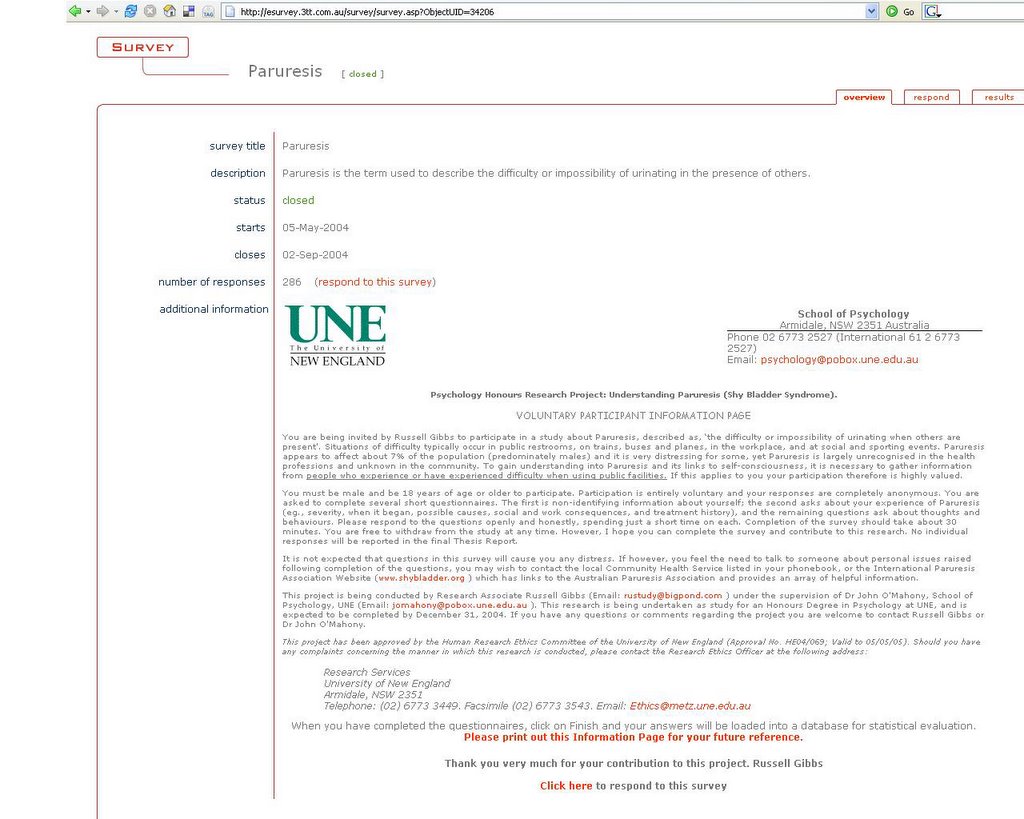
From May to September 2004 an Australian, Dr Russell Gibbs carried out an internet study of 286 men suffering with Shy Bladder at the University Of New England (UNE).
It's a pity that the study is now closed. Here's a screenshot of the front page :

The URL, if you're trying to make it out is :
http://esurvey.3tt.com.au/survey/survey.asp?ObjectUID=34206
I logged in with the userid "pta" and the password "pta010"
If you missed taking part (as I did) then at least you can read the results of that research here.
Sadly the results don't show what the questions asked were although it hints at the following questions being asked in some way :
1. Your age
2. Your level of education
3. When did shy Bladder start for you
4. Where did shy bladder start for you
5. Location : Country and/or State
6. Marital status
7. Do you feel anxiety when using a public restroom?
8. Does failure to urinate cause you stress?
9. Do you feel others are judging you when you void?
10. Do you search for vacant restrooms?
11. Do you use the stalls instead of using the urinal?
12. Do you restrict your liquid intake?
13. Has the condition limited your job opportunities?
14. Can you only urinate at home?
15. Have you ever sought help for the condition?
17. What treatments have you tried (check all that apply)
18. Has your condition improved or worsened with time?
19. Have you ever been asked to provide a urine sample?
21. If you have not been asked to provide a urine sample, could you if asked?
22. (A set of questions about your feelings and self-awareness, eg. are you shy? etc)
It would be great to read the original questions. I hope there will be further research into this field and that wider access to the data will be provided in future.
You can contact the author at gibbs.psychology@bigpond.com
It's a pity that the study is now closed. Here's a screenshot of the front page :
The URL, if you're trying to make it out is :
http://esurvey.3tt.com.au/survey/survey.asp?ObjectUID=34206
I logged in with the userid "pta" and the password "pta010"
If you missed taking part (as I did) then at least you can read the results of that research here.
Sadly the results don't show what the questions asked were although it hints at the following questions being asked in some way :
1. Your age
2. Your level of education
3. When did shy Bladder start for you
4. Where did shy bladder start for you
5. Location : Country and/or State
6. Marital status
7. Do you feel anxiety when using a public restroom?
8. Does failure to urinate cause you stress?
9. Do you feel others are judging you when you void?
10. Do you search for vacant restrooms?
11. Do you use the stalls instead of using the urinal?
12. Do you restrict your liquid intake?
13. Has the condition limited your job opportunities?
14. Can you only urinate at home?
15. Have you ever sought help for the condition?
16. If yes, after how many years?
17. What treatments have you tried (check all that apply)
a) Psychotherapy
b) Graduated Exposure Therapy
c) Self Help Group
d) Medication
e) Cognitive Behavioural Therapy
18. Has your condition improved or worsened with time?
19. Have you ever been asked to provide a urine sample?
20. If yes, were you able to?
21. If you have not been asked to provide a urine sample, could you if asked?
22. (A set of questions about your feelings and self-awareness, eg. are you shy? etc)
It would be great to read the original questions. I hope there will be further research into this field and that wider access to the data will be provided in future.
You can contact the author at gibbs.psychology@bigpond.com
Recovery Stories
The Shy bladder Institute has a number of recovery stories.
I wanted to examine these stories and see what the common threads were. Here's my summary :
Am I cured? (JohnW)
A cure story from Don in CA
Cured by knowing International Paruresis Association exists
My Successful Road to Recovery
One Year Since....Telling Others....Self Acceptance....and Success
Conclusions
I have to admit it's not a great data-set. It may be that many people who make full recoveries don't take the time to report them and are just glad to be free. There are a few conclusions that I draw from this breakdown :
0. You CAN make a full recovery.
1. Getting cured takes time but you can improve your condition quickly.
2. Just knowing that this is a real condition that other normal people suffer from is a form of therapy in itself.
3. Graduated exposure therapy is a component of all recoveries reported - the person who found out about the condition and was instantly "cured" still could not face using the urinal.
5. Professional help is a component of all full recoveries reported.
5. Drug therapies should not be discounted but they were always used in combination with Graduated exposure therapy.
As you can see, we are lacking good data on sucess stories. So for the record, here's me :
I wanted to examine these stories and see what the common threads were. Here's my summary :
Am I cured? (JohnW)
Age Shy Bladder Started : 16
Reason : Not stated (hints could have been faster with support)
Age at posting : 63
Started Treatment : mid-30's
Time for cure : Not stated
Full Cure : Yes
Treatments tried :Graduated Exposure Therapy
Professional counselling
Meditation/Relaxation
A cure story from Don in CA
Age Shy Bladder Started : 13
Reason : Bullied in Bathroom
Age at posting : 44
Started Treatment : 43
Time for cure : 1 year
Full Cure : Yes
Treatments tried :Graduated Exposure Therapy (also using Pee-Buddy)
Support group through IPA website
Read all available material on Paruresis (Shy Bladder)
Professional counselling (Psychiatrist)
Seratonin based Medications
Self-Hypnosis tapes
Religious faith
Cured by knowing International Paruresis Association exists
Age Shy Bladder Started :15
Reason : Bullied in Bathroom
Age at posting : 33
Started Treatment : 33
Time for cure : Immediate
Full Cure : ? (Says still can't use Urinal)
Treatments tried :Just knowing that this was a real condition and they were not alone effected an immediate relief of symptoms
My Successful Road to Recovery
Age Shy Bladder Started :Not stated
Reason : Not stated
Age at posting : Not stated
Started Treatment : Not stated
Time for cure : Not stated
Full Cure : No (Still in progress)
Treatments tried :
Found IPA Website (support)
Graduated Exposure Therapy
One Year Since....Telling Others....Self Acceptance....and Success
Age Shy Bladder Started :Not stated
Reason : Not stated
Age at posting : Not stated
Started Treatment : Not stated
Time for cure : Approx. 1 year.
Full Cure : No (Still in progress)
Treatments tried :
Found IPA Website (support)
Read the book
Group ShyBladder therapy (through IPA)
Medications : Lexapro and Lorazepam
Telling other people (support)
Graduated Exposure Therapy (with Pee-Buddy)
Relaxation (Phobease)
Conclusions
I have to admit it's not a great data-set. It may be that many people who make full recoveries don't take the time to report them and are just glad to be free. There are a few conclusions that I draw from this breakdown :
0. You CAN make a full recovery.
1. Getting cured takes time but you can improve your condition quickly.
2. Just knowing that this is a real condition that other normal people suffer from is a form of therapy in itself.
3. Graduated exposure therapy is a component of all recoveries reported - the person who found out about the condition and was instantly "cured" still could not face using the urinal.
5. Professional help is a component of all full recoveries reported.
5. Drug therapies should not be discounted but they were always used in combination with Graduated exposure therapy.
As you can see, we are lacking good data on sucess stories. So for the record, here's me :
Age Shy Bladder Started :16
Reason :Teased in bathroom / Just Developed.
Age at posting : 36
Started Treatment : 36
Time for cure : Approx. 2 months
Full Cure : No (Still in progress)
Treatments tried :
Telling wife (support)
Found IPA Website (support)
Read the book
Graduated Exposure Therapy
Hypnosis for Shy Bladder?
Today I saw this website that offers a downloadable hypnosis mp3 for the treatment of Shy Bladder.
The price is $8.95 but it's not clear how long the material is or what you're really getting for the money.
In his success story (at the IPA website) "Don" mentions that he used self-hypnosis tapes as part of his full recovery.
As for me, I'm going to stick with the desensitization technique. I want to see how far I can get with just that.
But if you have tried to use hypnosis in the treatment of your Shy Bladder please post your experiences so we can all get the benefit of your experience.
The price is $8.95 but it's not clear how long the material is or what you're really getting for the money.
In his success story (at the IPA website) "Don" mentions that he used self-hypnosis tapes as part of his full recovery.
As for me, I'm going to stick with the desensitization technique. I want to see how far I can get with just that.
But if you have tried to use hypnosis in the treatment of your Shy Bladder please post your experiences so we can all get the benefit of your experience.
Monday, February 27, 2006
In the stall
Today I had occasion to use a stall in the bathroom - for the reason they're provided - not as a shield for my Shy Bladder.
It seemed strangely unfamiliar and I realized that I hadn't been in the stall for weeks. I felt that my relationship with the stall had returned to a pre-Shy Bladder footing at least.
I'm not sure it really means anything but I'm noting it anyway.
It seemed strangely unfamiliar and I realized that I hadn't been in the stall for weeks. I felt that my relationship with the stall had returned to a pre-Shy Bladder footing at least.
I'm not sure it really means anything but I'm noting it anyway.
Thursday, February 23, 2006
Progress Report #12 : Maintenance?
I've had a couple of busy work days and I just didn't have the time or determination to really test myself. If I was on a diet, these would have been the days I succumbed to the donuts.
On the positive side, I didn't retreat back into the stalls and I kept up the water drinking but I decided to use Urinal #1 instead of the center.
End result is that on four of my bathroom trips people came in and used the far urinal a few moments behind me. Suffered no hesitancy and all seemed quite normal but on a focused day that would have been four tests that might have moved me forward.
I need to complete my tests with taking the center stall and only initiating once someone has stood up next to me. Once I've mastered that I'll need to find a more crowded bathroom where I can work on walking up to a crowded urinal.
Maybe this weekend I'll get a chance to test myself in a mall or bar.
On the positive side, I didn't retreat back into the stalls and I kept up the water drinking but I decided to use Urinal #1 instead of the center.
End result is that on four of my bathroom trips people came in and used the far urinal a few moments behind me. Suffered no hesitancy and all seemed quite normal but on a focused day that would have been four tests that might have moved me forward.
I need to complete my tests with taking the center stall and only initiating once someone has stood up next to me. Once I've mastered that I'll need to find a more crowded bathroom where I can work on walking up to a crowded urinal.
Maybe this weekend I'll get a chance to test myself in a mall or bar.
Wednesday, February 22, 2006
Progress Report #11
I should have a definate plan for today but I'm not sure what it is. Maybe just "maintenance" trying to keep the advances I've made alive. I feel like I've made some big leaps. The one from the stall to the urinal was huge. This lack of focus might prove to be a problem, it could make it easy to slide backwards but I'll see how it goes.
Attempt #1 :I guess I'm just in the habit of testing myself so I'll stick with the "Attempt" moniker. Went to the bathroom with urgency about 8/10. Had been chugging water all morning as normal. Standing there at the center urinal waiting. After 2 minutes I succumbed to weakness and just started to go. Lucky for me a co-worker came in after a few seconds and took the urinal next to me. There was a time when I would have had a surge of anxiety at the door opening. I've been in that situation before and watched my flow shrink to a dribble and stop. Not this time though, everything was normal.
I know my recent successes don't mean I'm cured. It just means I've managed to push my Shy Bladder anxiety beyond the situations I'm currently being challenged with. Will I be able to go at a crowded sports stadium trough?
Attempt #2 :This time I wait at the center urinal. Urgency 9/10. Another guy comes in, I start to pee, he goes to the stall, comes back and takes the urinal next to me. I know him, we chat. All is normal.
Starting to look like I need a new challenge.
Attempt #3 :I'm in the bathroom with an urgency of about 7/10. I take the center urinal. While I'm waiting I decide, on a whim really, to test myself by waiting until the other person comes in and stands next to me before starting my stream. Normally in these situations I'm starting my stream as soon as they come in. So, someone comes in. They stand next to me. Nothing happens. It turns out that it's someone I know, he starts some small talk but I'm still not able to go. I don't have a rush of anxiety but I can't go until he's finished up and flushes. The moment he's not actually standing at my shoulder I'm able to go. Failure. But I have identified a new challenge. Frustrating that my Shy Bladder has so many levels but I am determined to break down every one in turn. Should probably be able to manage this with a higher urgency level.
Attempt #4 :I take up position in the empty bathroom. Center urinal. Urgency 9/10. I wait a few minutes then someone comes in. I get a spike of anxiety and the guy takes the urinal next to me. I'm not sure if I'm going to be able to go or not, the urgency is overriding my anxiety at least. After a second of hesitancy I start to go, a good, normal flow. I know the guy, he says, cryptically "You enjoy standing there?" English isn't his first language so it's hard to know what to make of the statement, you can't always read things into what he says. I laugh it off, say I had some things to think about. He makes some small talk. We finish up. Maybe he saw me jump when he came in? Anxiety starts to blow this out of proportion : Have people noticed my hanging around in the bathroom? It seems unlikely - it was probably a comment about me standing at the center urinal. Overall a success.
Attempt #5 :Someone is in the bathroom washing their hands. I walk up and use the urinal with no hesitation. Wanted to test myself again with someone standing next to me but the conditions don't always work out that way. Will have to take this up tomorrow.
Further reading :
Read what happens next in Progress Report #12
Attempt #1 :I guess I'm just in the habit of testing myself so I'll stick with the "Attempt" moniker. Went to the bathroom with urgency about 8/10. Had been chugging water all morning as normal. Standing there at the center urinal waiting. After 2 minutes I succumbed to weakness and just started to go. Lucky for me a co-worker came in after a few seconds and took the urinal next to me. There was a time when I would have had a surge of anxiety at the door opening. I've been in that situation before and watched my flow shrink to a dribble and stop. Not this time though, everything was normal.
I know my recent successes don't mean I'm cured. It just means I've managed to push my Shy Bladder anxiety beyond the situations I'm currently being challenged with. Will I be able to go at a crowded sports stadium trough?
Attempt #2 :This time I wait at the center urinal. Urgency 9/10. Another guy comes in, I start to pee, he goes to the stall, comes back and takes the urinal next to me. I know him, we chat. All is normal.
Starting to look like I need a new challenge.
Attempt #3 :I'm in the bathroom with an urgency of about 7/10. I take the center urinal. While I'm waiting I decide, on a whim really, to test myself by waiting until the other person comes in and stands next to me before starting my stream. Normally in these situations I'm starting my stream as soon as they come in. So, someone comes in. They stand next to me. Nothing happens. It turns out that it's someone I know, he starts some small talk but I'm still not able to go. I don't have a rush of anxiety but I can't go until he's finished up and flushes. The moment he's not actually standing at my shoulder I'm able to go. Failure. But I have identified a new challenge. Frustrating that my Shy Bladder has so many levels but I am determined to break down every one in turn. Should probably be able to manage this with a higher urgency level.
Attempt #4 :I take up position in the empty bathroom. Center urinal. Urgency 9/10. I wait a few minutes then someone comes in. I get a spike of anxiety and the guy takes the urinal next to me. I'm not sure if I'm going to be able to go or not, the urgency is overriding my anxiety at least. After a second of hesitancy I start to go, a good, normal flow. I know the guy, he says, cryptically "You enjoy standing there?" English isn't his first language so it's hard to know what to make of the statement, you can't always read things into what he says. I laugh it off, say I had some things to think about. He makes some small talk. We finish up. Maybe he saw me jump when he came in? Anxiety starts to blow this out of proportion : Have people noticed my hanging around in the bathroom? It seems unlikely - it was probably a comment about me standing at the center urinal. Overall a success.
Attempt #5 :Someone is in the bathroom washing their hands. I walk up and use the urinal with no hesitation. Wanted to test myself again with someone standing next to me but the conditions don't always work out that way. Will have to take this up tomorrow.
Further reading :
Read what happens next in Progress Report #12
Tuesday, February 21, 2006
Can you really be cured of Shy Bladder?
This is a question I ask myself from time to time. As my progress shows you can certainly recover from it, taking back your life through Graduated Exposure Therapy and maybe other treatments. Based on my progress so far I expect to be able to make a full recovery some day (maybe soon).
But what form will that recovery take? My observation of the mensroom tells me that everyone suffers from some hesitancy and everyone has some avoidant behavior. Give a guy a choice of a urinal next to someone else and an open stall and a certain percentage will choose that open stall. I've seen this in action over and over.
With Shy Bladder this hesitancy and avoidance behavior spirals out of control. It's not just sometime, it's all the time.
Do sufferers have a pre-disposition to the condition? If so, can you eradicate the underlying cause or are we simply wired that way? If I cure myself through Graduated Exposure Therapy will I stay cured? Or will I inevitably slide back into it and be forced to confront my Shy Bladder time and time again?
People have reported curing themselves of Shy Bladder. But are these rare cases? I don't know, I'm not sure anyone does. I do know that Graduated Exposure Therapy is working for me and if I do slip back I now have a system to defeat it again.
I've had a couple of great days where it was as if I was free from the condition only to slide back again so I know that just because you think it's over doesn't mean it is. I accept the fact that I am going to have to continue to challenge myself and not allow my avoidant behavior an opportunity to come back in.
Even when I'm symptom-free I suspect it will be easy for me to avoid using a public restroom and "wait until I get home" when at the crowded mall. If I never get that kind of thought again, maybe then I can truly call myself cured.
Further reading
Analysis of recovery stories from Shy Bladder Institute Website.
Analysis of Shy Bladder from an Internet-based study carried out in 2004.
But what form will that recovery take? My observation of the mensroom tells me that everyone suffers from some hesitancy and everyone has some avoidant behavior. Give a guy a choice of a urinal next to someone else and an open stall and a certain percentage will choose that open stall. I've seen this in action over and over.
With Shy Bladder this hesitancy and avoidance behavior spirals out of control. It's not just sometime, it's all the time.
Do sufferers have a pre-disposition to the condition? If so, can you eradicate the underlying cause or are we simply wired that way? If I cure myself through Graduated Exposure Therapy will I stay cured? Or will I inevitably slide back into it and be forced to confront my Shy Bladder time and time again?
People have reported curing themselves of Shy Bladder. But are these rare cases? I don't know, I'm not sure anyone does. I do know that Graduated Exposure Therapy is working for me and if I do slip back I now have a system to defeat it again.
I've had a couple of great days where it was as if I was free from the condition only to slide back again so I know that just because you think it's over doesn't mean it is. I accept the fact that I am going to have to continue to challenge myself and not allow my avoidant behavior an opportunity to come back in.
Even when I'm symptom-free I suspect it will be easy for me to avoid using a public restroom and "wait until I get home" when at the crowded mall. If I never get that kind of thought again, maybe then I can truly call myself cured.
Further reading
Analysis of recovery stories from Shy Bladder Institute Website.
Analysis of Shy Bladder from an Internet-based study carried out in 2004.
Subscribe to:
Posts (Atom)